KA Readiness Test (KART) Explained

Erika Kinney, CPA · Partner and Head Coach, Gevorg CPA. Current as of November 16, 2026.

The Knowledge Assessment (KA) gives candidates from many different backgrounds a new way into the CPA Professional Program. It also raises a question we hear every week: am I ready to write it? The GCPA KA Readiness Test (KART) gives you a real answer before you commit your time and money to the KA.

In this blog, we will summarize the key details of the KA, and then cover the details behind the new tool that we made to assess your readiness to take on the studying for this new optional entrance exam.

First, a quick refresher on the KA

Let’s start with a grounding in what the KA is. We have integrated our other resources that provide more detail within this description as well.

What the KA is

CPA Canada calls the KA an optional entrance exam. There are two ways into the new CPA Professional Program: you either have 45 credit hours in accounting and business courses from a Canadian or international post-secondary institution that CPA recognizes, or you pass the KA. This is in addition to the other entrance requirements. See the full details here. CPA PREP, the old route for candidates without those courses, is being phased out.

Once you pass the KA (or meet the course requirements), you start in Foundational Development, Module 1 of the program. Our post CPA Foundational Development Exam Explained covers that step, as well as the modules that follow in completing your CPA requirements under the new CPA Professional Program.

Who can write it

Not just anybody can write the KA. There are certain eligibility requirements you need to meet, which include a degree, 120 credit hours and a 65% average. CPA Western School of Business’s Knowledge Assessment page has the official details, including the cost and planned offerings. Our post CPA Knowledge Assessment Explained walks you through two quick questions to help you decide whether you need the KA at all.

To visualize what this means for candidates, let’s say an individual with a degree in Sciences, who worked for a few years decides on a career change, and wants to pursue accounting. In the past, their only option would be to go back to school, complete either CPA PREP, or another Diploma in Accounting style program to obtain the necessary pre-requisite courses. Now, they would have a second path, which would be to independently study, and challenge the KA.

How the KA tests you

  • 150 objective-format questions in two timed parts (Part A and Part B), over 5 hours
  • Closed book: no Handbook, no Income Tax Act, nothing. (unlike the Modules in the new CPA Program which are open book to the Handbook and Tax Act)
  • Part A covers assurance, data analytics, ethics and governance, finance, non-financial reporting, strategy, tax and the foundational competencies (such as economics and law), at 10 to 15% each
  • Part B splits evenly between financial reporting (50%) and management decision-making (50%)
  • You need a pass in financial reporting and in management decision-making on their own, plus a pass overall

For the full picture, read Analyzing the New CPA Professional Program Exam Blueprints or watch the video. For how the KA fits into the whole program, see 2027 CPA Professional Program (CPAPP) Explained.

That breadth, with no references to fall back on, is exactly why so many candidates want to know where they stand before they book the KA.

What the KA Readiness Test is

The KART is a half-length, timed practice KA. We built an online testing portal to simulate an exam experience for students, including a timer that shows how much time you have left, to simulate the urgency you will encounter in an exam. After you write and submit this, we will mark your exam and email you your results, a performance review, and a very detailed solution guide to debrief with.

  • 75 questions in 2.5 hours, half the length of the CPA KA Exam (150 questions in 5 hours)
  • Part A has 45 questions and Part B has 30, the same split as the real KA
  • Every KA topic area, with the same weighting the KA uses
  • A running timer that you can’t pause
  • Our team marks it and sends results by topic in 2 business days
  • Introductory price: $100 per paper

Each paper is a one-time assessment. Once you’ve written Paper 1, you can’t write it again. Paper 2 covers the same mix of topics with completely different questions.

The KART is deliberately a little easier than the real KA. Its job is to show you whether your foundation is in place. If it is, you’re ready to start practicing for the KA itself.

Why we built it

The KA is a new optional entrance exam that CPA Canada offers alongside the new CPA Professional Program. What makes it different is who is eligible to write. Candidates coming from all kinds of paths can take this exam. Some might have completed part of an accounting degree years ago, some studied something else entirely, and some built their knowledge on the job.

That makes it hard to know where you stand.

  • How much do you remember from a course you took a long time ago?
  • How much of what you know from work will show up on the exam?
  • Am I ready to write it? Do I need to take some of the courses or should I challenge the exam as is?

We saw early on that candidates needed a way to measure this, and so did we as coaches. Our goal was to provide an exam-style paper on a clock, with marking from people who coach CPA candidates every day, to offer you an honest starting point.

Who should take it

  • You’re considering the KA as your way into the CPA Professional Program and aren’t sure you’re ready.
  • You took accounting courses a while ago and want to know how much you still remember.
  • You’re relying on work experience and want to see how it holds up against the exam’s topics.
  • You trained outside Canada or in another field and want a baseline before you plan your studying.
  • You’ve started studying and want an honest check on your progress.

When to take it

Take Paper 1 before you decide when to write the KA, and before you build your study plan. Your results show which areas you can ease off on and which need real work. If you did well in finance, you can spend less time there for now. If you struggled with financial reporting, that’s a sign to take a course on it before you sit the KA.

Save Paper 2 for later in your prep. Because its questions are new, it gives you a fair second measure of how far you’ve come.

For students who enroll in our KA Review course, we recommend using the KART as a calibration assessment to see how they have progressed in their studying, without burning through the limited resources students have for practicing full KA level exam questions.

How it works

1. Sign in or create your account

On the KA Readiness Test page, click Take the KA Readiness Test today! and go to the sign-in page. Enter your email address. New and returning users both get a one-time sign-in code, so there’s no password to remember. Use an email you check, because we send your results there.

2. Open Tests and choose a paper

The portal opens on CPD courses. Click the pencil icon to open Tests, then scroll down to see the available papers. Click into a paper to read its description.

3. Buy your paper

Each paper costs 2 credits ($100). New accounts start with 0 credits, so you’ll enter your card details when you buy. Your paper then appears under Purchased.

4. Start when you’re ready

You don’t have to write the paper the moment you buy it. Log out, block off 2.5 hours, and come back when you can focus. Once you click Start test, the timer runs and you can’t pause it. That’s deliberate: we want the KART to feel like exam day.
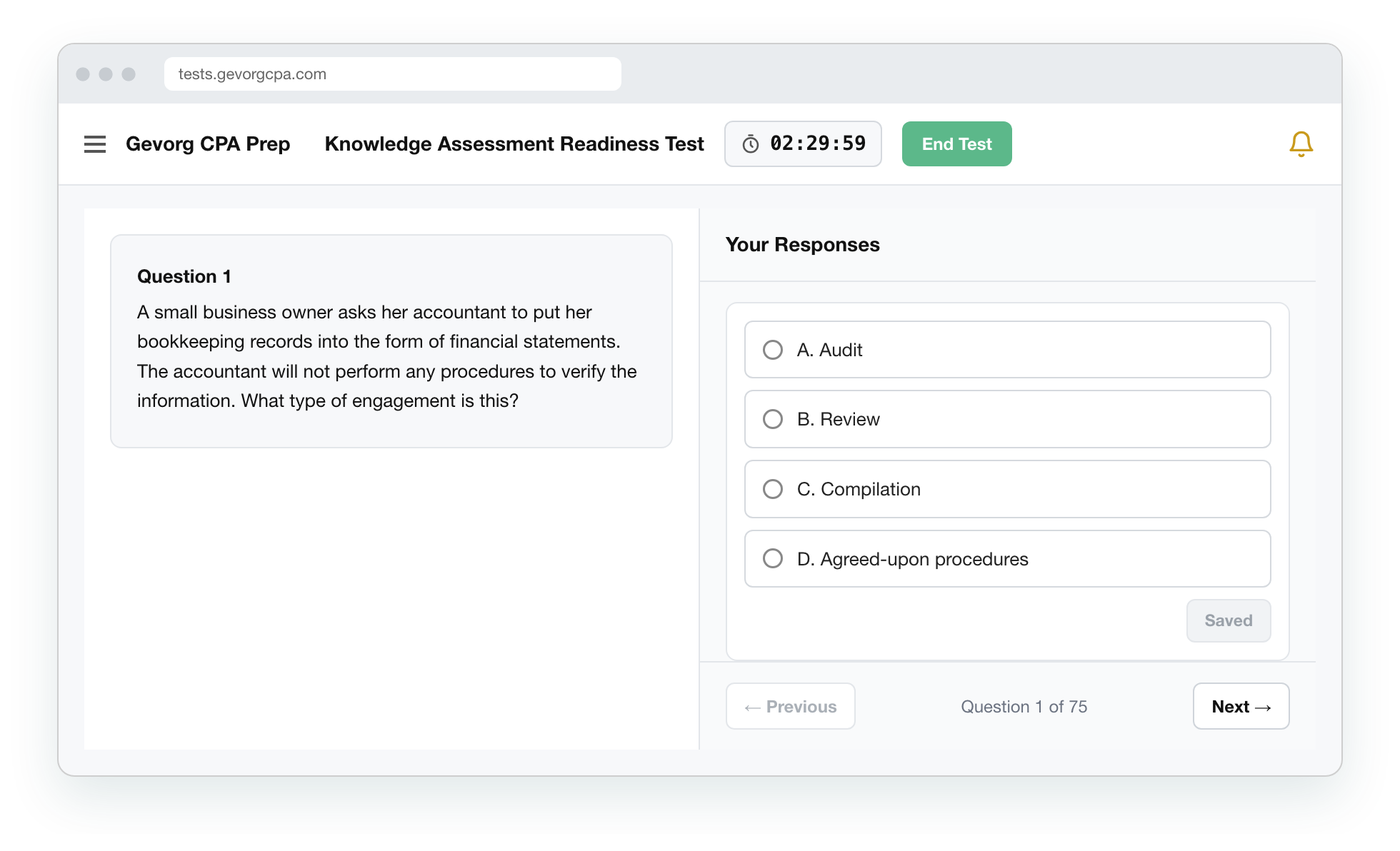
The KA Readiness Test in the GCPA portal, showing Question 1 of 75, the answer choices and a 2.5-hour countdown timer

You write the test in the GCPA portal, with one timer for the whole 2.5 hours.

5. Write Part A and Part B

We recommend going in order and noting how much time you have left when you switch to Part B. For questions with more than one correct answer, type your choices with a comma between them (for example, A,B). Click Save answer before moving on. If you have any unsaved answers, the portal reminds you before you submit.

6. Submit for marking

Click Submit test for marking and confirm. As on the real exam, you can submit even if you leave some questions blank. Your result shows as pending under Results while our team marks it.

What’s in your results package

Our team marks every test by hand, so results aren’t instant. Within 2 business days, you’ll get a PDF by email with:

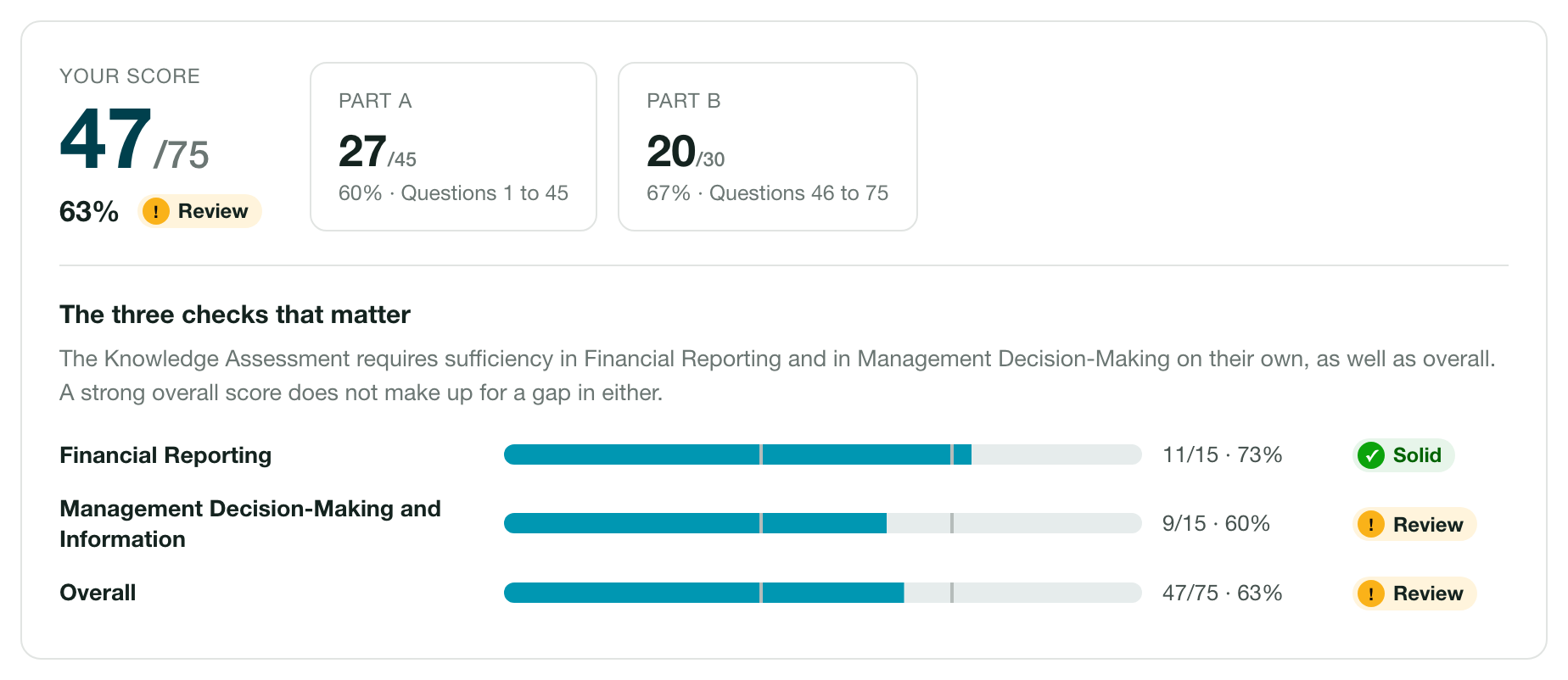
  • Your overall mark, and your marks for Part A and Part B
  • Separate results for Financial Reporting and Management Decision-Making, since you need to pass each of these on the KA
  • Your performance by topic area
  • A question-by-question breakdown by technical competency area
  • A full solution guide

Sample KA Readiness Test results: 47 out of 75 overall, Part A and Part B scores, and separate checks for Financial Reporting, Management Decision-Making and Overall

Sample results. We check Financial Reporting and Management Decision-Making on their own, as the KA does.

For every question, the solution guide shows your answer and the correct answer, with a detailed explanation: why the correct answer is right, which references support it, and why each of the other options is wrong. It doubles as a study guide.

How to use your results

Read through the solution guide and ask yourself one thing about each question: does this look familiar? If the explanation clicks and you think “I knew that,” you’re probably close on that topic. If you read the answer and still have no idea what it’s about, that topic needs real study before you write the KA. Both reactions tell you what to study next, and whether you’re ready to challenge the KA now.

Prefer to watch? We walk through the KART in our new video: The GCPA KA Readiness Test on YouTube.

Common questions

Where can I learn more about the KA itself?

Start with CPA Knowledge Assessment Explained, then read Analyzing the New CPA Professional Program Exam Blueprints or watch the video. Our YouTube channel has the rest of our CPA Professional Program series.

Is this the GCPA KA exam prep course?

No. The KART is a one-time assessment that shows where you stand. GCPA KA Exam Prep is a separate, full prep course, and it’s coming soon. Join the mailing list to hear when it opens.

If I do well, am I ready to write the KA?

Not yet. A good result means your foundation is in place and you’re ready to start practicing for the KA. The KA itself is harder, and exam prep gets you ready for it.

Can I write the same paper twice?

No. You can write each paper once. To test yourself again, buy the other paper. More papers are coming soon.

How long do results take?

Up to 2 business days. Our team marks each test and prepares your feedback by hand.

Do I need a separate account for CPD?

No. The same login gives you your assessments, future papers and GCPA CPD courses.

How much does it cost?

The introductory price is $100 per paper (2 credits).

Ready to see where you stand?

Paper 1 and Paper 2 are available now. 75 questions, 2.5 hours each, $100 per paper.

Take the KA Readiness Test today! →

CPA resources

Links as at November 16, 2026.

CPA Knowledge Assessment Explained

Current as of October 12, 2026. Dates are CPA’s and subject to change.

150 questions. Five hours. And nothing to look up.

That’s the Knowledge Assessment, the first exam anyone can sit in the new CPA Professional Program. CPA has now released the Exam Guide, issued August 27, 2026, with the blueprint for every exam. In this post we go deep on just this one: whether you need to write it, how it’s structured, what’s on it, what CPA’s sample questions show, and whether it can really replace your university courses. We walk through one question to show you what that means, and finish with what we think will be trickiest.

It’s the written version of our video, CPA Canada 2027 Knowledge Assessment: New Optional Entrance Exam Explained. For all five exams at a high level, see Analyzing the New CPA Professional Program Exam Blueprints and its video.

At a glance

Item Detail
What it is An optional entrance exam
Format 150 objective-format questions, in two timed parts
Time 5 hours
Reference materials available during the exam None
To pass Sufficiency on financial reporting, on management decision-making, and overall
Disclosed? No
First sitting March 23, 2027

Source: Exam Guide; CPA Western School of Business schedules.

Do you need to write it?

CPA calls the Knowledge Assessment an optional entrance exam. You can enter the CPA program either by having the required prerequisites (a degree and specific accounting and business courses) or by passing the Knowledge Assessment instead. You still need a university degree to write it, but the accounting-specific courses are no longer required: a pass lets you in without them.

The easiest way to work out whether it’s for you is three questions.

Question 1: Do you already meet all the prerequisites to enter the program? That means a degree or equivalent, at least 120 credit hours of post-secondary education, a 65% average on your most recent 60 credits, and 45 credit hours of accounting and business courses. At least 21 of those hours must cover intermediate financial reporting, advanced financial reporting, management accounting, finance, assurance and taxation. Introductory courses don’t count.

  • If yes, you don’t need the Knowledge Assessment. Apply for admission and go straight to Foundational Development, Module 1.
  • If not, go to question 2.

Question 2: Do you meet the requirements to write the Knowledge Assessment? You need the degree, the 120 credit hours and the 65% average. What you’re missing is the accounting and business coursework.

  • If yes, you can register for the Knowledge Assessment.
  • If not, complete those requirements first (for example, finish your degree), then come back to question 2.

Question 3: Did you pass?

  • If yes, you’ve met the accounting and business requirement, and you have five years to start Foundational Development.
  • If not, you can write it again. After a third failure, you have to wait one year before the next attempt.

The eligibility rules are on CPA Western School of Business’s admission requirements page. The five-year window and the one-year wait come from the Education and Experience Policies, Western Region draft of May 2026, which may change before launch.

The logistics. It costs $1,000 plus GST and is offered three times a year (Knowledge Assessment page).

Sitting Date
First March 23, 2027
Then September 16, 2027
January 20, 2028
May 18, 2028
September 14, 2028

Source: CPA Western School of Business schedules, updated August 25, 2026.

Structure

150 objective-format questions over five hours, in two parts, each timed separately. That works out to an average of two minutes per mark.

Part Questions Time
A 90 3 hours
B 60 2 hours

CPA says the question types may include multiple choice, multiple select, fill in the blank and drop-down list, and that the list isn’t exhaustive.

Content

Part Topic Weight
A Assurance and trust 10 to 15%
A Big data and data analytics 10 to 15%
A Ethical decision-making and governance, including data governance 10 to 15%
A Finance 10 to 15%
A Non-financial reporting 10 to 15%
A Strategy, risk management and innovation 10 to 15%
A Tax 10 to 15%
A Foundational competencies 10 to 15%
B Financial reporting 50%
B Management decision-making 50%

Source: Exam Guide.

The foundational competencies are economics, along with quantitative methods and probability; law and legal forms of business; organizational behaviour; and sustainability. Value creation isn’t tested on its own: CPA integrates it into the other topics.

Management decision-making is CPA’s “Management Decision-Making and Information (Data) Systems/Technology”. At this level it covers preparing budgets and forecasts, determining variances, costing calculations, cost-volume-profit and break-even analysis, pricing, describing responsibility centres and incentives, and describing IT, AI and systems implementation (Module Guide).

It’s a knowledge exam. The Module Guide says the Knowledge Assessment does not assess the Decision Competencies.

Passing and reference materials

To pass, you need sufficiency on financial reporting, sufficiency on management decision-making, and sufficiency on the exam overall: each one separately. It’s a non-disclosed exam.

And there are no reference materials. No Handbook, no Income Tax Act, nothing. It’s the only exam in the program where that’s true. Keep that in mind, because it matters a lot for what comes next.

What CPA’s sample shows

CPA has published sample Knowledge Assessment questions: 31 questions, all multiple choice. CPA Western School of Business says a full sample exam will be available in early 2027 (Knowledge Assessment page). We anticipate the full sample may show the other question formats.

Does it replace the university courses?

Here’s the question a lot of candidates will be asking: if I pass the Knowledge Assessment, do I skip the accounting courses altogether?

Technically, yes. Passing it meets the accounting and business knowledge requirement, in place of the 45 credit hours of courses. For students who can self-study well, saving the time and money of a full accounting program is a big deal. What you need to think through, though, is how you’ll learn and absorb this material without a course. That isn’t to talk you out of the Knowledge Assessment, but to help you make an informed choice.

To picture what you’d need to know, here’s one financial reporting question, worked step by step. It’s our illustration, not a CPA sample question.

A company signs a five-year lease for equipment. It pays $20,000 at the end of each year. The interest rate implicit in the lease is 6%. The company reports under IFRS.

Select the carrying amount of the lease liability at the end of year 1.

A. $69,302
B. $84,247
C. $80,000
D. $64,247

Step 1: Recognize what’s being tested. It’s a lessee under IFRS, so this is IFRS 16. The lessee puts the lease on the balance sheet as a right-of-use asset and a lease liability, and the liability is measured at the present value of the lease payments, not their total.

Step 2: Measure the liability on day one. Five payments of $20,000 in arrears at 6%. The five-year annuity factor at 6% is 4.2124, so the liability is $20,000 × 4.2124 = $84,247.

Step 3: Record the lease, then roll the liability through year 1.

When Account Debit Credit
Day one Right-of-use asset $84,247
Day one Lease liability $84,247
End of year 1 Interest expense ($84,247 × 6%) $5,055
End of year 1 Lease liability $5,055
End of year 1 Lease liability $20,000
End of year 1 Cash $20,000
End of year 1 Depreciation expense ($84,247 ÷ 5) $16,849
End of year 1 Accumulated depreciation, right-of-use asset $16,849

The interest uses the effective interest method: the opening liability times the rate. So the liability goes $84,247, plus $5,055 of interest, less the $20,000 payment, which is $69,302. Depreciation doesn’t change the liability, but it’s part of the same year-one picture.

Step 4: Choose, and know why the others are wrong.

Option What it is
A. $69,302 Correct: day-one liability plus interest, less the payment
B. $84,247 The day-one liability: forgets the interest and the payment
C. $80,000 $100,000 of payments less one: never discounts
D. $64,247 Takes off the payment but forgets the interest

Each wrong answer is a specific mistake. If you only half know the method, there’s an answer waiting for you.

What you’d normally learn this from. Present value and annuity factors, from finance. The effective interest method, from intermediate financial accounting. IFRS 16 itself, and how ASPE differs: under ASPE, the lease is first classified as capital or operating, and an operating lease stays off the balance sheet. And this is one topic. Financial reporting on this exam also covers revenue, inventory, property, plant and equipment, deferred tax, business combinations, investments and more, under both IFRS and ASPE (Module Guide).

So, can it replace the courses? On paper, yes. In practice, you still have to learn everything those courses teach, well enough to apply it without notes, across every topic area. For disciplined self-studiers, or anyone taking online courses to prepare, it can be a faster and cheaper route. For everyone else, think carefully about how you’ll actually learn the material before choosing it.

What we think will be trickiest

Our read of the blueprint, not CPA’s. It’s here to give you a feel for the exam, not to tell you how to study.

The breadth. This is the biggest challenge. Seven topic areas plus the foundational competencies in Part A, at 10 to 15% each, and two full subjects in Part B. There’s no topic you can leave out. You need the depth of that lease question across seven topic areas, which is why many students take two years to work through this material.

Nothing to look up. Every other exam gives you the Handbooks and both tax acts. Here, everything has to be in your head. In our opinion, this matters less than it sounds for prepared students: if you don’t know how to approach a lease calculation, having IFRS 16 open in the exam is unlikely to help you fast enough. We don’t think the closed-book format will be the deal breaker.

Formats you haven’t seen. The sample is all multiple choice, but the real exam may include multiple select or fill in the blank, where you can’t eliminate options or guess your way to a one-in-four chance.

One open question: the Exam Guide’s content table for the Knowledge Assessment lists the foundational competencies but not the sub-foundational ones (equity, diversity and inclusion; Indigenous views; emerging technologies). Whether those are examinable here isn’t settled yet.

The bottom line

The Knowledge Assessment is optional, 150 questions, five hours, and nothing to look up. If you’re not sure whether you need it, start with question 1 and check your courses against the 45-credit-hour requirement.

Gevorg CPA

Planning for the Knowledge Assessment? Reach out to us

Whether you’re deciding when to start the new program or how to prepare for this exam, the Gevorg CPA team is here to help. Get in touch with your questions, and visit our CPA Professional Program page for more detail on the new program.

Want to know when our exam resources for the new program are available? Join our 2027 program mailing list and we’ll let you know.

Next in this series: Foundational Development, the first exam most candidates will write.

CPA resources

Links as at October 19, 2026.