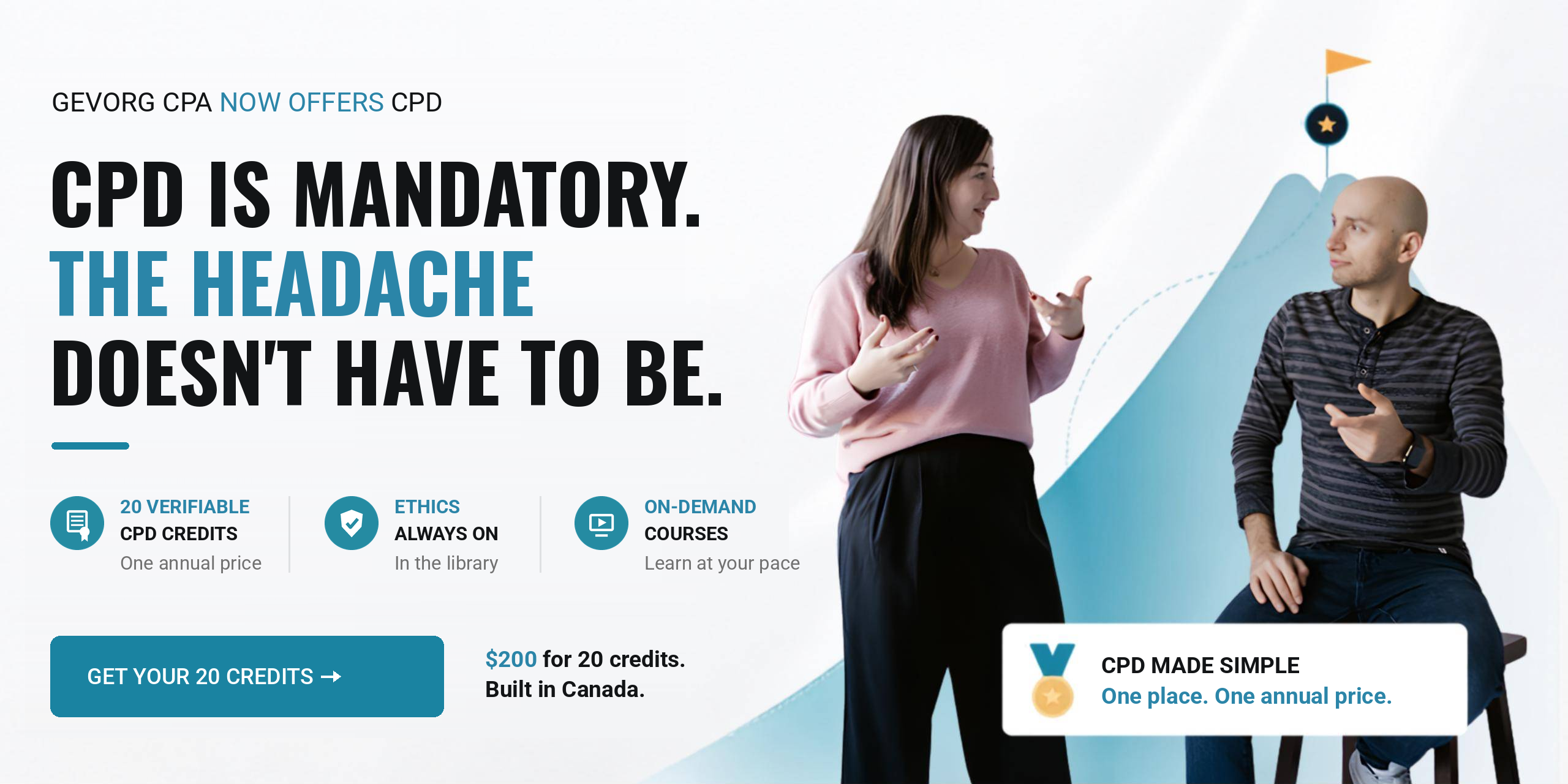
After years of students asking us if GevorgCPA provides CPD, we finally launched it! Starting in November, we are proud to offer our new continuing professional development offering for Canadian CPAs. With that launch, we wanted to put out a post that explains both what we offer and how the CPD requirements for CPAs actually work. We outline general CPD requirements first, and then tell you more about our new CPD offering at the end.
The short version: most Canadian CPAs need at least 20 hours of CPD a year and 120 hours over every rolling three-year period, with at least half of those hours verifiable and four of them in professional ethics. You ultimately report your hours to your provincial body, and not CPA Canada. While the CFE and PEP process was predominantly common across provinces, CPD is slightly different, so make sure you know your provincial body’s specific rules.
This post reflects the rules as of November 2026. Requirements and reporting standards change, so always check your provincial CPA body for the most up-to-date rules before you declare.
What CPD is, and why it matters
Continuing professional development (CPD) is the learning you do after you earn your designation to keep your skills current. Earning the CPA designation proves you were competent on the day you qualified. CPD is how you show you are still competent years later, as standards, tax rules and technology change around you.
For CPAs, CPD isn’t optional. It is a condition of keeping your membership, and with it the right to call yourself a CPA. Each provincial body requires members to complete a minimum number of hours, declare them every year, and keep records in case they are selected for review.
The requirements
Outside Québec, the provincial bodies apply the same headline numbers. CPA Ontario, CPABC, CPA Alberta, CPA Manitoba, CPA Saskatchewan and CPA Nova Scotia all publish the same rule.
| Requirement | Minimum hours | How it is measured |
|---|---|---|
| Every calendar year | 20 hours, at least 10 verifiable | January 1 to December 31 |
| Every rolling three-year period | 120 hours, at least 60 verifiable | The current year plus the two before it |
| Professional ethics | 4 verifiable hours | Within each rolling three-year period, counted inside the 60 verifiable hours |
Two details trip people up:
- The 20-hour annual minimum won’t get you to 120. Twenty hours a year for three years is only 60. You need an average of 40 hours a year, or bigger years to make up for lighter years.
- The three-year window rolls. Each year, the oldest year drops off and the newest one is added. Every year you must look back over the last three years and confirm you hit 120 hours, 60 verifiable and 4 ethics.
We cover verifiable vs non-verifiable CPD below.
Québec works differently. The Ordre des CPA du Québec requires at least 120 hours per three-year reference period, with a minimum of 25 hours each year. It uses the term “structured” training rather than “verifiable”, caps self-learning, and requires 4 hours of structured professional ethics training, including its mandatory course on the Code of ethics. Québec CPAs should follow the Ordre’s own program and reporting dates.
Public accounting licence holders may have extra hours in specific areas. Check your province’s licensing rules.
When the requirements start
The obligation starts once you are admitted as a member, and the first-year rules vary by province.
- CPA Ontario: if you are admitted on or before September 30, you must complete the full annual requirement that year. If you are admitted after September 30, you are exempt for that first year only.
- Most other provinces: new members report CPD for the calendar year they are admitted. Some have transitional relief for the three-year requirement.
The current rolling structure is newer than many CPAs realize. CPA Ontario’s last fixed three-year period ended December 31, 2018, and the first rolling three-year period began January 1, 2019, to align with international standards. The 4-hour ethics requirement applied starting with the 2019 to 2021 period.
CPA Canada vs the provinces: who sets the rules?
This is the part that confuses most people. CPA Canada is not your regulator. The accounting profession is regulated provincially, so your CPD obligations come from your provincial (or territorial) CPA body, such as CPABC, CPA Alberta, CPA Ontario or the Ordre des CPA du Québec. That body admits you, grants your designation, sets the CPD rules, audits your CPD and handles discipline.
CPA Canada is the national organization. It represents the profession nationally and internationally, supports the standard setters, publishes the CPA Canada Handbook and offers professional development of its own. It has never been the body that enforces your CPD hours.
How the relationship has changed
For about a decade, the provincial bodies and CPA Canada worked together under a Collaboration Accord, first set up in 2013 when the profession unified. Under that model, provincial bodies collected a CPA Canada fee from every member, so most CPAs were automatically members of both.
That model has now ended.
| When | What happened |
|---|---|
| April 1, 2026 | CPA Canada membership became voluntary across the country. Provincial bodies stopped collecting CPA Canada fees, and CPAs who want to stay members now join CPA Canada directly. The Atlantic bodies made the same change as Ontario and Québec on this date. |
| January 15, 2026 | CPA Canada announced its new voluntary membership model. |
| December 20, 2024 | CPA Ontario and the Ordre des CPA du Québec formally ended their affiliation with CPA Canada, after withdrawing from the Collaboration Accord. |
| 2013 | The Collaboration Accord was set up as the CPA profession unified. |
What that means for your CPD
Nothing about your hours changed. Your CPD requirement, your designation and your right to use it all come from your provincial membership, whether or not you also hold a voluntary CPA Canada membership. Provincial bodies have said they will keep collaborating on education and standards, and members still have access to the CPA Canada Handbook through their provincial body.
Verifiable vs non-verifiable CPD
Verifiable CPD is learning that leaves evidence someone else can objectively check. Non-verifiable (or unverifiable) CPD is relevant learning that leaves no independent evidence. Both count toward your total hours, but at least half must be verifiable.
CPA Alberta’s test for verifiable documentation is a useful checklist. Your record should show:
- Who provided the activity
- What the activity covered
- When it took place
- How you took part
- Enough to show the hours you claimed are reasonable
| Usually verifiable | Usually non-verifiable |
|---|---|
| Courses, webinars and e-learning with a certificate or completion record | On-the-job learning, such as a new system or a big change in duties |
| Conferences, seminars and workshops with proof of attendance | Casual reading of professional journals and magazines |
| Structured in-house training run by your employer | Self-study without an exam or certificate |
| Formal study toward a degree, diploma or designation | Technical reading and research with no output |
| Teaching or presenting, including preparation time within limits | Volunteer or community leadership that builds your skills |
| Serving on boards or technical committees, with minutes or confirmation | |
| Research or writing that produces a report, article or presentation |
A note on online learning
Online and on-demand courses can absolutely count as verifiable, but how you complete them matters. CPABC, for example, treats online CPD as verifiable only if it involves successfully completing an exam or certification. Watching a recorded webinar on your own, with no assessment, is usually non-verifiable. Look for on-demand courses that end with a final assessment and a certificate (just like GCPA CPD does!).
What doesn’t count at all
CPA Ontario lists volunteering that doesn’t lead to a verifiable activity, networking events with no learning component, language courses taken on their own, and activities unrelated to your CPA competencies.
What counts as ethics
Ethics hours must be verifiable and should go beyond reading the rules. CPA Ontario expects examples or scenarios that apply them to real decisions. Typical topics include the CPA Code of Professional Conduct, independence and conflicts of interest, whistleblowing, anti-money laundering, and bribery and corruption.
Where to get CPD
You don’t have to take CPD from your provincial body, or even in Canada. CPABC, for example, says CPD can come from any learning institution, organization, employer or online source, and that it doesn’t accredit third-party providers. The responsibility is yours: choose learning that is relevant to your role, and keep the right evidence.
Common sources include:
- Your provincial CPA body. Most run courses, webinars, conferences and local chapter events.
- CPA Canada. Its store offers courses, webinars and conferences.
- Your employer. Structured in-house training is generally verifiable when it has proper records.
- Universities and colleges. Formal courses toward a degree, diploma or certificate count.
- Other professional bodies and associations. Industry groups, tax foundations, governance institutes and specialist designations.
- Online and on-demand CPD providers. Self-paced courses you can fit around work, ideally with a final assessment and certificate so the hours are verifiable. Like us at GevorgCPA!
- Teaching, speaking, writing and committee work. These can count when they are relevant and documented.
Many CPAs use a reliable on-demand source to cover their core verifiable and ethics hours, then spend the rest of their time and budget on conferences, specialised training and the learning that is specific to their job.
Reporting, records and exemptions
- Declare every year. Each province has its own deadline. CPA Ontario’s declaration window runs April 1 to June 1 for the previous calendar year, and late filers can face fees and eventually suspension.
- Keep your records. You usually don’t submit evidence with your declaration, but you must produce it if you are audited. CPA Ontario asks members to keep CPD records for five years.
- Expect audits. Provincial bodies review a sample of members every year.
- Exemptions exist, but they are narrow. Most provinces offer full or partial relief for retirement, parental or medical leave, unemployment and other extraordinary circumstances. You generally still have to file a declaration, and your requirement is pro-rated for the year.
- Watch for province-specific extras. CPABC, for example, requires all members to complete 1.5 hours of anti-money laundering PD by December 31, 2026, which can also count toward ethics hours.
The bottom line
CPD is mandatory, but it doesn’t have to be a headache. Know your province’s rules, aim for about 40 hours a year with at least 20 verifiable, get your 4 ethics hours done early in the cycle, and keep your certificates in one place. Spread it across the year and you’ll never face a December scramble.
This post is general information, not regulatory advice. Your provincial CPA body has the final word on your requirements, so check its CPD page before you declare.
Our offering: GCPA CPD
Now that we’ve set the groundwork, we’re really excited to tell you about our new offering! Our students have been asking us for CPD for years, so we built it in the same style you know from our exam prep: practical, efficient and to the point.
What you get
- $200 for 20 verifiable CPD credits, valid for one year. One credit equals one verifiable hour.
- Over 40 on-demand courses across ethics, tax, audit and assurance, leadership, governance, ESG and public practice management, with more coming in December and the new year.
- Short, independent modules you can take a chunk at a time and come back to later.
- A final assessment and certificate for every course, downloadable right from your portal and ready for your provincial CPD report.
- Written and reviewed by CPAs, fact-checked against current Canadian standards and legislation, with sources on the slides.
- Clear labelling of which courses are taught live and which use digital narration, so you know before you enrol.
- Built in Canada. Platform coding and content writing are all done locally.
Why ethics is always in the library
Every CPA needs 4 verifiable ethics hours in each rolling three-year period. We keep ethics-eligible courses in the library at all times, covering the CPA Code, independence, anti-money laundering, AI ethics and ethical leadership. You can get your ethics hours whenever it suits you, without waiting for a session to come around.
Why credits come in a bundle of 20
Twenty hours is the annual CPD minimum, so we built one simple bundle around it: one price and no per-credit math. Everyone needs a different amount. Some CPAs need all 20 credits, others need just 5 or 10 to top up after a conference or in-house training. Even if you only need 5, $200 is still an easy price point, and the rest of the library is there if you want it.
Why it frees up the rest of your learning
When your core verifiable and ethics hours are taken care of in one place, you don’t have to chase every single credit. That leaves your time and budget for the learning you really want: the conference with the great network, a specialised course for your role, or something that’s just for you.

Get your 20 verifiable CPD credits
$200 for 20 credits, valid for one year, with ethics always in the library. Learn more and get your credits on our GCPA CPD page.
Sources
- CPA Ontario: Continuing Professional Development
- CPA Ontario: A Simple Guide to CPD Requirements
- CPABC: CPD Requirements
- CPABC: CPD Sources
- CPA Alberta: Verifiable vs. Unverifiable CPD
- CPA Manitoba: Continuing Professional Development
- CPA Nova Scotia: CPD Reporting
- Ordre des CPA du Québec: Programme des activités de formation continue 2025
- CPABC: CPA Canada Dues and Membership Changes
- CPA Saskatchewan: CPA Canada Fees and Membership Changes
- Treasury Board of Canada Secretariat: Additional Provinces Terminate Affiliation with CPA Canada
- The Globe and Mail: Ontario and Québec accounting bodies are leaving national CPA
Links as at November 10, 2026.