Posts

CPA PEP Finance Review

This Finance Elective coaching program teaches the core concepts of Finance and Management Accounting (MA) for CPA Canada’s Finance module in a clear, simple and structured way. You’ll receive a break-down of the technical areas you need to understand, how to think through Finance problems, and exam strategies on time management, outlining, formatting, and overall exam technique. This coaching program will help you build strong skills and confidence in applying Finance concepts under exam conditions.

CPA PEP Taxation Review

This Tax Elective coaching program teaches the core concepts of CPA Canada’s Tax module in a clear, simple and structured way. You’ll receive a break-down of the technical areas you need to understand for Tax, how to think through Tax scenarios, and exam strategies on time management, outlining, formatting, and overall exam technique. This tutoring program will help you build strong skills and confidence to pass Tax concepts under exam conditions

CPA Canada 2021 Pass Rates Released

Update: 2022 pass rates are now released. Please see the updated post here.

CPA Canada has now released the 2021 PEP and CFE pass rates.

2021 CFE Pass Rates

Below are the official pass rates as reported by CPA Canada:

CFE Offering

Cumulative Pass Rates

First Attempt

Second Attempt

Third Attempt

May and September 2021

73.6%

n/a

n/a

September 2020

75.8%

n/a

n/a

September 2019

76.3%

87.4%

n/a

September 2018

77.6%

87.5%

90.8%

September 2017

77.6%

88.1%

90.6%

September 2016

76.8%

88.6%

91.4%

May 2016

68.7%

75.4%

79.9%

September 2015

82.9%

94.6%

96.6%

In 2021, there were two offerings of the CFE. The 73.6% pass rate is the combined average on both the May and September 2021 CFEs. Overall, there is a decrease of 1%-2% year over year, with an average of 75% rate.

2021 PEP Pass Rates

CPA PEP Module

2021 Pass Rate

2020 Pass Rate

2019 Pass Rate

Core 1

77.1%

81.9%

79.4%

Core 2

85.3%

86.2%

84.3%

Taxation

88.1%

88.0%

88.1%

Assurance

90.5%

89.1%

89.2%

PM

90.9%

90.7%

90.6%

Finance

89.1%

89.0%

89.9%

There are marginal decrease overall in the PEP (Core 1, Core 2) while other modules have stayed flat.

PEP and CFE Exam Coaching

My name is Gevorg. I’m an instructor and a CPA exam coach. If you need helping passing your CPA exams, contact me for consultation or check out my courses.

CFE Review by Gevorg CPA


It’s the Busy Season, How to Balance CPA CFE Studies with Work

Sticking to CPA studies during the busy season is tough. If you work in public practice, whether Big 4, mid-size or smaller firms, you know the audit and tax seasons are grueling. In the industry, the year-end closure and audits are not much fun.

Here are 5 tips from Leela Pai, successful CFE writer from Sep 2021, to help you align yourself with your study schedule and not stress over the busy season.

1. Use a Planner

Set out your priorities for the week. Be it work related, study or personal time. Ensure you mention all things you need to complete for the week so as to be able to complete your work within the deadlines and at the same time ensuring your CFE studies are not affected. 

There will be days you won’t progress due to road blocks – don’t bog yourself down. You can always make adjustments to the schedules and that’s the beauty of a planner – quantifying all you have to do in the week, while being flexible. Here’s a sample study plan you can use:

2. List down the topics

Make a list of all those topics which you believe are challenging and those that you believe are easy. Jot them down and make the schedule in a way so that on hectic days you work on easy topics. Otherwise, you’ll feel like you haven’t studied for CFE – that guilt leads to more anxiety which would result in reduced productivity.

3. Take breaks and stay active

Ensure you take breaks.  Too much work combined with studies may burn you out way too early. It’s important to feel refreshed, especially when we read technical books or debrief cases, your mind should be fresh so as to retain all those concepts.

4. Write in your own words

Even though you may have summaries from mentors/classmates etc., I advise students to make their own notes as they are comfortable with their own way of writing. These notes should be as brief as possible so that you can revisit them during quick work breaks or when you have a couple minutes before bed, personal breaks etc. These personal notes work like flash cards and when it’s in your own writing, you tend to relate to them and remember much better

5. Make up your mind

Last but not least, it’s important to mentally prepare yourself. If you decided to write the May CFE, then there is no looking back. You might have to put in extra hours due to the busy season but this will allow you to enjoy your summer, compared with students who chose September CFE. The September CFE writers  will give up their summer to be able to prep for CFE. Take some time off, remember to breathe and decide if you plan to take it up – then abide by the saying “YOU CAN, YOU WILL, YOU MUST!”

Conclusion

Studying for the CFE during the busy season is challenging. If you need support or coaching, get in touch with Gevorg for a free consultation call. 

How To Write An Effective Audit Planning Memo In CPA Canada Cases

If you have selected Assurance as an elective in your CPA Canada PEP, or it’s your role for the CFE, writing an effective audit planning memo will be the key to achieving multiple competent grades. Let’s walk through the 4 steps of writing an effecting audit planning memo: Risks, Approach, Materiality, Procedures (abbreviated as RAMP).

1. Identifying Overall Financial Statement Level (OFSL) Risk 

Your first step in writing an audit planning memo will be to assess the overall financial statement level risks (OFSL). OFSL represents the risk of an audit engagement and risk of material misstatements (RMM). This assessment will be the foundation of determining what approach should be used to gather the appropriate evidence, the level of materiality we should accept, and the procedures required to form an audit opinion. 

It’s important to analyze case facts for factors that either increase or decrease the level of risk. A well-rounded risk response will contribute some form of a balanced response between the two. As you read the case initially, mark factors you can refer back to for this assessment opportunity.

For example, in the case below, the second paragraph says: “We’re growing at an incredible pace and we can’t keep up.” This is a trigger that increases the audit risk.


When writing your response, using bullets is a great strategy to use time effectively. Each bullet should discuss what the risk is and why the impact increases or reduces overall risk. Students who don’t achieve “Competent” are often the result of not having a sufficient amount of risks, or lacking depth in the risk impact. Be sure to only discuss new risk factors for this year.

Some common risk factors include:

  • Bank will be relying on bank covenants imposed on Company ABC. This increases OFSL risk as there is a risk of management bias to ensure financials meet the covenant.
  • There are several F/S errors present. This increases OFSL risk that there are additional accounting errors that have yet to be identified.
  • We have audited Company ABC for several years. This decreases OFSL risk as we are familiar with the business and their processes.
  • Company ABC has implemented a new software this year. This increases OFSL risk as we are unfamiliar with the controls surrounding the new software and this could be resulting in errors in the financial statements.

Be sure to conclude if the OFSL is high, moderate or low, and why (i.e. high because factors increasing risk outweigh factors that decrease risk). The vast majority of the time you’ll conclude the OFSL risk as high due to the nature of CPA exams.

For example, here is an effective way to write the risks and conclude:


2. Identifying the Audit Approach

To determine the overall approach for gathering audit evidence, assess the control risk on an overall basis. If controls can be relied on, typically a combined approach will be used. If controls are determined to be weak, a substantive approach is concluded. To conclude on this, identify case facts related to the control environment, the nature of the business, and explain the impact of these items on the audit. 

Some common considerations include:

  • New systems and processes. Will increase control risk as these processes have not been relied on before and auditors are unfamiliar with them. 
  • Company ABC has multiple locations. This will make it difficult for auditors to visit and apply a substantive approach on all locations. 

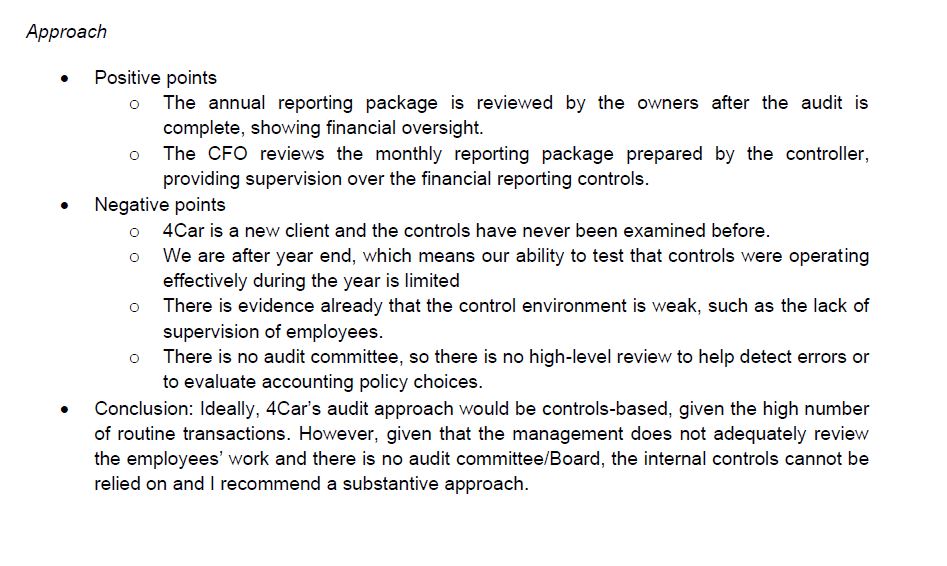
For example, here’s how the approach was written for this mock exam case:
3. Determining Materiality

Materiality is a product of user needs, not audit risk. Therefore, you must identify the key users of the F/S and what their needs are. For example, potential investors may be concerned with overall profitability, but the Bank could be more interested in debt and equity based on covenants. Understanding these user needs will provide support for your chosen materiality base. Calculate materiality where possible on revised F/S (after corrections). 

Performance Materiality (PM) is based on the auditor’s professional judgment, and is associated with the risk of the engagement. This serves to mitigate errors that may not be detected during the testing phase. You should get in the habit of being able to include both overall and PM in your CPA case answers.

For example, here’s a complete materiality section:

4. Preparing Procedures

Procedures should be written for high risk transactions, accounts or assertions. When writing audit planning memo in CPA cases, it’s often written for all Financial Reporting (FR) issues. You should identify the specific risk, the related assertion and then the procedure. For this reason, procedures are often abbreviated to “RAP” (risk, assertion, procedure). Here’s an example of a risk: “Company ABC has pressure to meet a debt to equity covenant from the bank. There is a risk that due to management bias, the accounts payable account for what is owed is not complete”. Then write the assertion, which would be completeness.

Below are all the audit assertions:

Transactions/Events (Income statement): Completeness, Occurrence, Cut-off, Classification, Accuracy (“COCCA”)

Balances (Balance sheet): Completeness, Existence, Rights & Obligation, Valuation/Allocation (“CERV”)

Presentation and Disclosure: Occurrence, Rights/Obligations, Completeness, Classification/Understandability, Accuracy/Valuation

In CPA cases, we most often use the Income Statement and Balance Sheet assertions. You can remember them with the saying: IS COCCA CCERV’d in BoSton. There are more clever memory aids in my technical summary notes.

Assertions should have the GL accounts next to them. For example, Completeness (A/P) shows the assertion and account. This is not necessary when you write the RAP with FR issues though (see example below).  

Audit procedures should be specific and detailed by demonstrating a step-by-step process. To be specific, you can use case facts such as referencing specific documents, accounts or procedures outlined for this company. The procedure should address how the risk can be looked into and how evidence will be acquired. You should also make sure their procedures are practical and realistic and avoid general statements. It also helps to write the procedures below the FR issues, as opposed to combining them at the end, because they are closely related to FR issues and you can reference FR as you write.

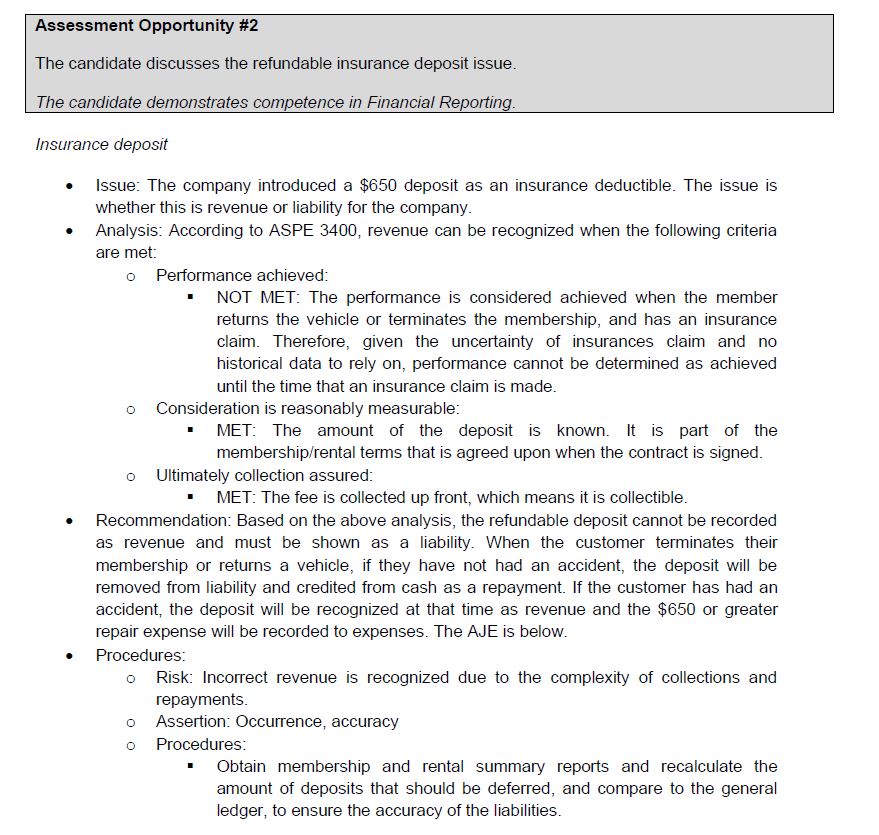
For example, here’s an FR issues with the audit procedure below it:
Some common procedures include:

  • Obtain copy of all materials related to R&D and review in accordance to above criteria to determine if costs should be capitalized
  • Obtain confirmation from management that ABC CO. plans to proceed with the R&D project to ensure the recognition criteria have been met
  • Discuss with management and corroborate their responses with the R&D team, as to whether the asset is likely to be fully developed and ready for market soon, and as to the progress made on the development.
  • Inquire and review if ABC Co. has complied with all terms of the agreement to determine if there are any additional unknown costs to include with the POC% calculation
  • Vouch a sample of the contract to the supporting contracts and any revisions made to these supporting contracts. Check for the date, contract amount, and any unusual terms.

Conclusion

Applying this structure for audit planning memo (APM) will ensure your assessment is complete and in-depth to achieve C (competent) grade. Practice the WHY and HOW of the impact for each step of the APM to make sure to hit depth.

5 Tips to Write CPA Canada Cases Faster for PEP and CFE

For many CPA candidates, sticking to the allotted case time is one of the major challenges in case writing. Being able to dedicate your time to the conditions being marked will be critical in achieving overall competency success.

1. Use common abbreviations

Time spent typing out full names of accounts, financial statements, company name, users’ names, etc. can be used alternatively towards further analysis with the use of abbreviations. However, be careful in only using common abbreviations that are well known in the CPA world. These will include terms you often see abbreviated in the modules, Knotia and practice cases. For example, you can use abbreviations such as P&L (Profit and Loss Statement), ABC method (Activity Based Costing method), A/R (Accounts Receivable), IRR (Internal Rate of Return), HB (Handbook), IFRS, ASPE, Quant (quantitative), Qual (qualitative), F/S (Financial Statement), AO(Assessment Opportunity) etc. Avoid using your own created abbreviations to eliminate potential confusion from the reader.

As a workaround, you can define your own abbreviation at the start of your memo in brackets, then use it throughout. For example, “Company ABC is interested in investing in buy-one-get-one (BOGO) products. The benefits of BOGO products are that…On the other hand, BOGO products have risks such as…” 

2. Don’t quote entire Handbook sections

Be sure when copying and pasting HB sections, that you only copy what is relevant. In other words, only the few sentences that you plan on analyzing and concluding on with case facts. Copying the entire HB section will not earn marks, and may in fact lead you to discussions that do not hit the key points. The HB section should be interpreted, as how you use the standards will be the main focus of your assessment grade. 

Debriefing your cases and keeping a summary of the relevant HB paragraphs and sections for reference will help provide ease when writing cases.

3. Only write what is necessary

When writing your AO analysis, it’s important to avoid the temptation to focus on the quantity of what you write and instead focus on being concise. Avoid long introductions for issues, and instead address the issue in a single sentence. Do not reiterate general case facts. Instead, your introduction could look like: “Susan is considered if revenue related to the sale of concert tickets have been recorded correctly”. This will leave you more time to get to the details of the task.

The same logic applies to your analysis. Condensing your analysis/conclusions of each point to 3 to 4 sentences should be enough to get the point across. If you are hitting the word limit on your assignments, you likely have some room to improve your ability to be brief. Take time when debriefing your cases to focus on what could have been removed / what was critical to include.

4. Apply formats for the specific analysis

Much of improving speed with case writing comes from knowing how to format specific AOs. By reviewing and templating these AOs during your debriefing process, you can eliminate some of the work upfront by already knowing how to set up your qualitative analysis or your Excel spreadsheet. As you do more cases, you will notice many AOs repeating over and over again.

Keeping track of how these are commonly answered and assessed on the Feedback Guide will allow you to spend more time on your actual answer, instead of formatting. For example, for a control weakness, get in the habit of setting up a WIR (Weakness, Implication and Recommendation) format. Or for Special Reports, practice laying out your response with the reports, assurance level, pros/cons etc. Additionally, you should consider whether using a table, paragraph or pros/cons is the optimal analysis.

5. Improve your typing speed

Time is driven by speed and distance. The above tips will help you reduce your distance (ie, you’ll write less). But how can you increase your speed? Most CPA candidates have an average typing speed of 40-45 words-per-minutes (WPM). By increasing the typing speed to 50-60 WPM, you can put more things down in shorter amount of time, thus earning more marks. Most students practice their typing 1-2 times a week using online tools. However, these tools use words and phrases that are irrelevant to CPA cases. SpeedType, on the other hand,  is tailored for CPA Canada candidates. It’s a typing training and time management tool that helps you type faster through lessons that cover all CPA Canada competencies. Practicing 2-3 times a week will ensure you’re typing faster and learning how to manage your time. Check out SpeedType here for free

Conclusion

Practicing these skills over the course of modules and capstones is the best way for CPA candidates to improve their time management and overall case-writing skills. Consider implementing this review as part of your case debriefing process.

Is a CPA Study Partner Right For You?

While many of us have studied independently throughout our education career, studying for CPA Canada PEP and CFE exams offers a unique opportunity to stay disciplined during the exam process. The following article provides several benefits to having a study buddy, while considering some limitations to overcome when selecting your study partner.

Benefits

  1. Holds you accountable: Since you will be creating a study schedule together, there is someone to hold you accountable to stay on track of timelines, case deadlines, case time constraints, etc. You’ll likely be meeting each other at set dates, so this forces you to finish your part before the meeting, thus helping you meet deadlines.
  2. Helps with your weaknesses: Your study partner could bring a unique CPA study skillset to the table to balance some of your weaknesses. This provides the opportunity to discuss complex topics and bounce ideas off of each other. This could also be helpful in learning from each other for creating a case plan and identifying case triggers.
  3. Supports with debriefs: Your study partner provides additional support for debriefing your CPA cases objectively. While CPA / facilitators will conduct marking still, it allows you to discuss competencies with someone, as opposed to only reading the feedback guide.
  4. Gives new insights: Reading and marking someone else’s cases gives you a unique insight into a new thought process and structure for cases that you may find helpful to adapt.
  5. Helps with learning: For technical review, there is the opportunity to split up difficult technical material between you two. You can each summarize the topics and teach them to each other. Explaining the information to someone else is a great way to test your understanding on the topic.
  6. Provides encouragement: Your study buddy offers you support and encouragement during the process. While you may have others in your life you can rely on, your study buddy is easily able to identify with your CPA journey.

Drawbacks and other considerations

  1. Different schedule: Your study partner may have a different working schedule, and studying alone would give you more flexibility. It would be beneficial to find a partner within your work or school to mitigate this. A virtual study partner could be just as effective as an in-person partner.
  2. Different expectations: Your study partner may not have the same expectations, work ethics, or skill set as you. This could hold you back from focusing on your main areas of concern. Finding a partner you know and trust as well as someone in the same CPA elective as you would be effective. A study partner who took a different elective can also help as they will have a better understanding of the competencies that you’re weak at.
  3. Time consuming process: Finding a study partner can often be a time consuming process. If you don’t know anyone in the program with you, there are several online resources to find a partner in your area. You can find a study partner at Gevorg CPA’s Facebook and WhatsApp groups here.

Overall, having a study buddy can be an asset but also an added variable to consider in your study plan. The shared motivation between study partners help foster a positive and confident study environment to ensure you both continue to push through the challenging times.

Find a CPA study partner

If you need helping finding a study partner, join my CPA PEP, CPA CFE Review and CPA PER Review courses where I will help you connect with like-minded students and ensure both of you succeed.

September 2021 CPA CFE Cases and Answers (Download)

Update: Please see these updated posts for May and September 2022 CFE exam cases download:

Similar to prior Common Final Exams (CFEs), the September 2021 CFE had Day 1, 2 and 3 cases. The following Day 1 cases were tested:

September 2021 CFE:

  • Waste Disposal Incorporated (WDI) v2 (download)
  • Distinct Hotels Corporation (DHC) v3 (download)

The following Day 2 and Day 3 cases were tested in September 2021 CFE:

  • Day 2 (download):
    • Farm Fresh to You Inc. (FFTY) (300 minutes)
  • Day 3 (download):
    • FenceCo (FenceCo) (90 minutes)
    • HSE Inc. (HSE) (80 minutes)
    • Amped Transit Ltd. (Amped) (70 minutes)

For the September 2022 CFE, the following Day 1 cases will be tested:

  • Waste Disposal Inc. case (WDI) v3
  • CanDo Fitness (CFL) v1

Where can I get these cases?

You can download by clicking on the hyperlinks above.  If you are registered for the Capstone 2 module for Summer 2022, you will receive these cases at the module. You can also simply download using the links above. If you are someone challenging the exam, such as an internationally trained accountant applying under MRA/MOU, also download using the links above.

Where can I get the solutions?

I have written my version of the solutions to September 2021 CFE cases, which you can get from here. The official solutions will be released in May, 2022, per CPA Canada’s announcement

How do I prepare for the CFE?

There are several prep methods for the CFE. You will need to focus on these three items:

  1. Technical knowledge
  2. Case writing skills
  3. Strategy

I speak a lot about these items on my YouTube channel and webinars. You can check out my latest webinar.

Technicals:

  • Know the key topics on each of the competencies
  • Distinguish depth from breadth
  • Debrief

Case writing skills:

  • It’s all about following the CPA Way
  • Know your case inside out
  • Integrate throughout the case

Strategy:

  • Prepare a study plan
  • Obtain study materials
  • Get support and resources

Pass the CPA Canada CFE Exam

I’m Gevorg. I’m an instructor and a CPA exam coach. If you want coaching with me, sign up for my CPA CFE Review Course, for a comprehensive prep package.

CFE Review by Gevorg CPA

4 Tips for Planning Your CPA Canada Goals for 2022

With the start of the new year, it’s the perfect time to make a clean slate and start thinking about what you want to accomplish in your CPA studies during 2022. Setting the standard as easily as possible will allow you to best use your time. This list will help you get started on how to set your new goals to ensure you reach your milestones, meet deadlines, and are kept accountable.

1. Evaluate yourself

To start planning for a goal, you should consider the things that you want to achieve. Categorizing what is important to you will allow you to create workable plans to get results. Be sure to write down these concepts. Individuals that write out objectives are more likely to accomplish them!

2. Define your goals

Once you have a high-level picture of your desires, you can get specific and define a course of action. Whether your goal is to complete all your PEP courses, pass the CFE, or achieve level 2 in PERT, ensure your goals are distinct and attainable. These goals should be separated into long and short term actions based on your priorities and your position.

The most effective way to set goals is by using the SMART method:

  • Specific – Being specific makes it easier to focus on a course of action. For example, instead of having the goal to study more, try being specific about the time you plan to study at, for example, 6pm to 8pm everyday.
  • Measurable – Be sure you can evaluate whether the goal was met. For example, aiming to achieve C in most AOs by the end of a module.
  • Achievable – Be realistic in what you can attain for the given year. Keep in mind CPA timelines of exams, work commitments, etc. to determine what is accurate for you to invest your time in given the resources available to you.
  • Relevant – Be sure to ask yourself if the goal is realistic and relevant to achieving your goal. For example, if your goal is to pass the CPA Tax exam, your goals should be focused on the Tax module, tax studying, etc.
  • Time-specific – Make sure your goals are consistent with your academics, work schedule and other responsibilities. Try to establish deadlines for each step of the process.

3. Execute your goals

As you execute and be consistent with your goals, priorities and circumstances may change. Your goals may evolve over time. It is important to recognize what is working and what is not, and revisit your goals frequently. For example, you may become unexpectedly busy at work, and using your lunch break to study may no longer be realistic. While it can be challenging to accept, it is important to recognize how a new or modified goal is a better course of action.

4. Overcoming Challenges

As you face certain challenges, you can set a goal on that particular issue. In some cases, overcoming a challenge might mean enlisting help. For example, if you are struggling with the CPA Core 2 module, it may help to find an appropriate tutor or study group.

There is no better time to start thinking ahead for what you want out of the upcoming year. It is not enough to have intentions, but the right framework to accomplish an idea. Setting goals will provide you with a greater sense of motivation and confidence. Be sure to reward yourself for your accomplishments!

Get effective CPA exam coaching

If you need helping passing your exams and completing PERT at Level 2, check out CPA PEP, CPA CFE Review and CPA PER Review courses for a comprehensive prep package and coaching.

CPA PER Review

This Practical Experience Requirement (PER)  program provides step-by-step walkthroughs of PER report writing, Level 2 examples, templates, marking services and more.