Posts

FR Competencies for CPA Canada’s Core 1

Core 1 covers Financial Reporting (FR), Assurance, Tax and Finance competency areas. I’ve written about Assurance, Tax and Finance common topics in other posts, I’ll cover the FR topics here.

Common FR topics to know for Core 1

Here are some of the common FR topics you should know for Core 1:

  • Revenue recognition
  • Lease accounting
  • Inventories
  • Property, plant and equipment (PPE)
  • Intangible assets
  • Tangible asset Impairment
  • Provisions, contingent liabilities
  • Non-monetary transactions (NMT)
  • Related party transactions
  • Government assistance
  • Subsequent events
  • Financial instruments (FI)
  • Decommissioning provision
  • Non-current assets held for sale
  • Accounting for income taxes
  • Business combinations
  • Investment in Associates
  • Foreign currency

All FR topics that can be tested

The above is a condensed list of frequently tested topics. The full list of FR topics that you can be tested on are listed in the CPA Canada Competency Map.


Get Help with Passing Core 1

Sign up for the Core 1 Review program to get extra practice cases, study plan, engaging video lessons and personalized coaching with me.


Assurance Competencies for CPA Canada’s Core 1

Before starting Core 1, it’s useful to review topics that are going to be taught and tested in this CPA module.

Core 1 covers Financial Reporting (FR), Assurance, Tax and Finance competency areas. I’ve written about FR, Tax and Finance topics in other posts, I’ll cover the Assurance topics here.

Common Assurance topics to know for Core 1

Here are some of the common Assurance topics you should know for Core 1:

  • Audit planning memo (Risk, Approach, Materiality, Procedures)
  • Assertions
  • Audit evidence
  • Analytical procedures
  • Special engagements
  • Reviews
  • Compilations
  • Control deficiencies

All Assurance topics that can be tested

The above is a condensed list of frequently tested topics. The full list of Assurance topics that you can be tested on are listed in the CPA Canada Competency Map.


Get Help with Passing Core 1

Sign up for the Core 1 Review program to get extra practice cases, study plan, engaging video lessons and personalized coaching with me.


Failed CPA CFE 3 Times? You Still Have Options

CPA Canada allows candidates to attempt the CFE three times. At each unsuccessful attempt, candidates can appeal and ask for re-marking. After three unsuccessful attempts and remarkings, candidates will automatically be de-registered from the CPA PEP program. If you’re in this situation, here are some options to consider.

1. Request 4th Attempt at the CFE.

Officially, you have three attempts at the CFE. However, it’s possible to write it for the 4th time. Candidates can present a letter to CPA Canada asking for a 4th attempt.  To be successful in this request, you must have a situating that was extraordinary, outside of your control and well documented. 

I have consulted candidates and successfully got them the 4th attempt. 

Update 2025: Due to popular demand, I now offer a dedicated mini-course to help you prepare a strong 4th attempt case and PER extension requests. Click on the image below to learn more:

2. Wait until 2027

As you may know, PEP and CFE are being changed from 2027. The new CPA certification program will not have Core 1/2, electives, MCQs, nor CFE. It will not focus on technicals, but rather on case writing and decision making. At the time of writing this article, we don’t have official details on the new program structure, however you can choose to wait until 2027 and register into the new program.

3. Take the U.S. CPA.

To take the US CPA exams, you don’t have to be a US citizen or go to the US. You can apply online and study from Canada. US CPA costs less than the Canadian CPA and there are only MCQs and short-form answers in the exam. I wrote a detailed post comparing both designations here.

4. Get ACCA

Becoming ACCA is another good alternative. ACCA stands for Association of Chartered Certified Accountants, it’s a globally recognized designation with strong recognition in the UK, Asia, Europe, and it’s highly valued in Canada too. Canadians can enroll in the ACCA program without leaving Canada, study online, and write the exams in designated exam centers. 

5. Pursue the CFA designation.

CFA (Chartered Financial Analyst) is a good certification if you want to grow in Financial Planning and Analysis (FP&A) role. You can expect the same salary as a controller / director who’s a CPA. Read more about the CFA program here.

6. Pursue Masters in Accounting degree.

The Masters in Accounting (MAcc) program will teach you the same technical competencies as PEP and give you post-grad certification. Some employers consider MAcc to be equivalent to CPA. You can read more about MAcc program here

8. Become a Registered Professional Accountant (RPA)

Based in Ontario, the Registered Professional Accountant (RPA) designation lets members practice accounting services, including tax and compilations (CSRS 4200). 

9. Focus on your career.

I have worked with several managers in the finance/accounting departments who did not have CPA or other certifications. Instead, they had extensive work experience and great networking skills. Employers tend to look closer at what companies applicants worked for, not their education.

Conclusion

There are many viable alternatives to the CPA. Step back and assess your professional goals. If pursuing CPA was for growth and a high salary, consider other designations or careers. Don’t give up and stay motivated.

If you’re considering a 4th attempt or need help with next steps, enroll in my new 4th Attempt & CPA Extensions course to learn more.


CPA Case Writing: Electronic vs Paper Outline for PEP and CFE

When writing CPA Canada PEP and CFE exams, planning your approach and AO times in an outline is a key component of passing. With the option to do the outline on paper vs. computer, many candidates question which approach is better. Check out the below considerations when deciding which method is best for you!

Paper Outline

Pros:

  • Outline will always be in front of you. You don’t need to spend time scrolling up and down to check your plan. This will help you better stick to your allocated time and ensure you are answering the AOs fully.
  • You have more flexibility in positioning and formatting the outline in the way you want. You can draw arrows, highlight, and circle key items on your outline easily. Computer outlines don’t provide the same flexibility.
  • You can easily cross off and markup AOs from your plan as you complete them. This will help you keep track of how many AOs you have left to complete and any that you need to return to. For example, you can put a “?” sign next to AOs you did not fully complete to remind yourself to return to them. In an electronic outline, the same question mark may get lost in the paragraphs of text.
  • You can easily highlight and match AOs with key background information and appendices directly, instead of relying on a summary (which could take more time to write/type out). For example, you can highlight in blue color an AO in the narrative. When you see case facts related to the same AO in appendices, you can highlight with the same blue color to keep track of the information. 

Cons:

  • Paper outline is more time consuming as handwriting takes longer than typing. This is valuable time taken away from preparing your answer.
  • There is a risk you may not be able to read your handwriting (if your handwriting is as bad as mine), or your outline could get smudged if you erase or rub it. This may cause you to miss out on critical points for your analysis. Electronic outlines don’t have the same problems.
  • Per CPA Canada exam rules, you can’t use a pen or mechanical pencil for the PEP and CFE exams. This will cause your writing to be messier as HB pencils are not as sharp.

Electronic (computer) Outline

Pros:

  • Allows you to prepare your answer faster, since you don’t have to re-write items from the paper outline to the computer once you’ve completed it. You can easily copy and paste items from your outline to your answer, or convert your outline into your final answer.
  • There is flexibility in re-ordering your electronic outline as you can easily change the ordering of AOs by cutting and pasting them to their new positions. You can also leave blank space between AOs in your outline so detail can be filled in as you read the case and gather more / new information. Paper outline doesn’t give the same flexibility because there is limited space.
  • You can create a time budget in Excel faster than on paper (see example here).
  • If you run out of time, you at least have something on your computer already to build your answer from, such as the key issue and critical case facts. You may get RC for this if you have enough relevant content.
  • You can build the structure of your response around your outline and less time is needed to restate the issue statements. This provides a smooth transition to typing out your answers.
  • There is reduced risk of missing a required that you forgot to transcribe from paper to your computer, assuming your computer outline is well organized.
  • Saves you time from flipping between case papers and outline to capture all the requireds.

Cons:

  • For long cases, you will have to scroll up and down from section to section to stick to your plan. This takes time and may cause you to lose track of AOs. To solve this, I recommend students to create their outline as a “skeleton” (by using templates) and convert it into their final answer. This is better than typing your entire outline at the top of the memo and copying below as your answer AOs.
  • You must capture all AOs and key case facts by typing them out. This will be more time consuming for long cases that have extensive detail, or if your typing speed is slow. The recommended minimum typing speed for CPA Canada exams is 40-45 WPM. You can check your typing speed here.
  • Typing out has shown to be less effective for remembering and interpreting information than writing them out by hand. 

Conclusion

I recommend electronic outline for most candidates due to its speed, flexibility and ability to convert your outline into your final answer. To be successful with electronic outlines, you must have good organization skills and efficient case writing. In my interviews with Honour Roll students, I found some students prefer paper outlines while others prefer computer outlines. Ultimately it’s not the method that defines your exam success, but your approach, organization and practice.

Regardless of the method chosen, you should be practicing your outlining skills on each case you write. Try attempting both methods and determine which one is most effective and efficient for you. I show examples of both outlines and explain how to outline like Honour Roll students in my PEP and CFE success courses.


Can You Leave Your Outline in CPA Canada Cases?

When preparing electronic outlines for CPA Canada PEP and CFE cases, many writers question whether this can be left in their memo or should it be deleted before submission.

The answer is YES, you can leave it, the markers are not concerned with having outline left in the memo. However, you must make it clear it’s only an outline. Here’s how to do that!

Step 1: Label your outline

I suggest putting a short “Outline” header at the top to make it clear. This includes both Word and Excel documents. For Word, simply write “Outline” at the top. For Excel, you may be using it to track the timing on AOs; make sure this is labeled as “time budget”, “tracker” or “outline” so that it’s not confused with an Exhibit.

Step 2: Keep it brief

Don’t make your outline very detailed, it’ll take valuable time and this could confuse the marker into thinking this is the final response. Your outline should briefly state the business information, users, requireds, any relevant appendices you need to refer back to from the case, a timeline, and for Excel the priority in which you will answer AOs and the time you are allotting for each. Outline should not contain technical criteria, attempt an analysis, or conclusion. Instead, keep it brief and save your longer write-up for the memo.

Step 3: Put outline at the start

It should be clear to the marker when your outline ends and when your memo begins. Some writers may choose to start the memo in a fresh new page, but this is not necessary.

What all writers need to do is put a header after the outline, to signal to the marker that the memo starts from that point onwards. The header should address who the memo is written to (user names), from (always “CPA”), what the memo is regarding (via a subject line; name of the company), and optionally the date the memo is written. Writing an introduction paragraph in CPA cases is not necessary; once you put the header, start solving AOs.

Conclusion

Markers will not penalize writers for keeping an electronic outline in your Word document. As long as you are keeping your outline and memo response distinct to avoid any marker confusion, you do not need to spend any additional time deleting your outline at the end of the exam. Having the outline there is a great reference to you to help you avoid flipping back and forth between hard copy case papers to track all the case facts. 


What Can be Tested in CPA Canada CFE Day 2?

Day 2 of the CFE is considered by many to be the hardest of all CFE days. You have to ensure that you achieve depth (ie, score C/CD) in as many AOs as possible. This article will help you find the key areas to study and explain how Day 2 works.

Structure of Day 2

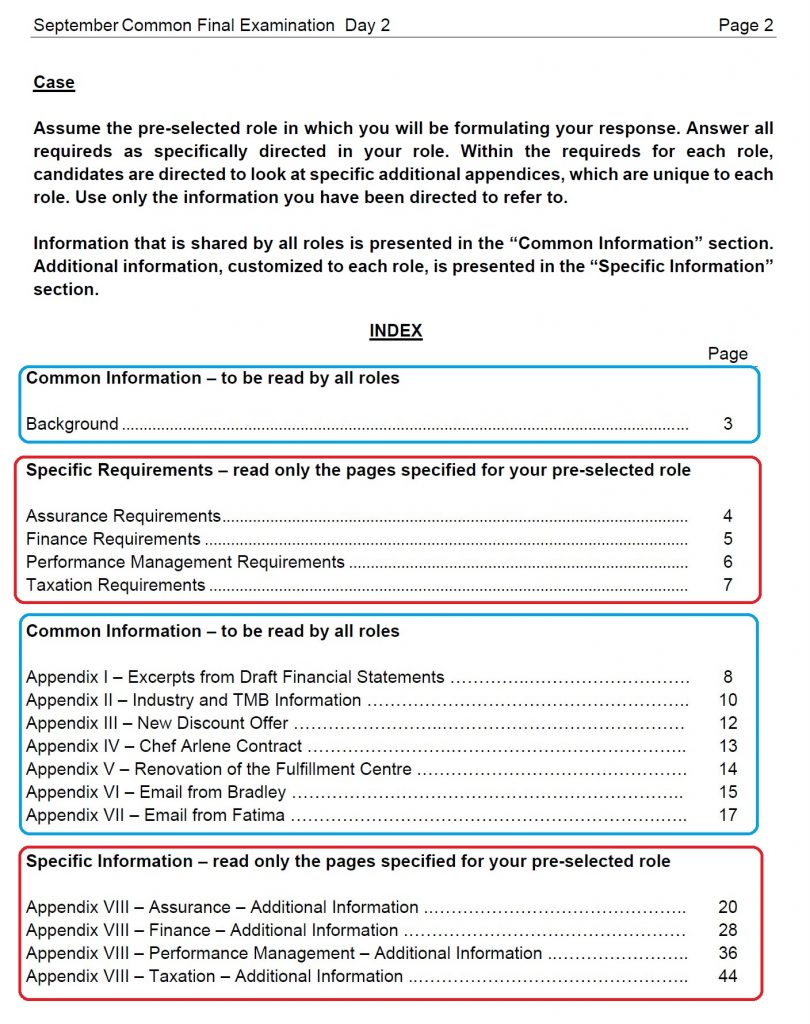
As I wrote in the Ultimate Guide to CFE blog post, Day 2 has one case that must be completed within 5 hours. It’s broken into two sections: Common AOs (blue below) and Role AOs (red below).

Common is the same for everyone writing the CFE. Role is based on the specific area that you choose and you have 4 options:

  • Assurance
  • Performance management (PM)
  • Tax
  • Finance

Common AOs

Common AOs test on FR and/or MA competencies only. The “and/or” here means you could get:

  • Only FR
  • Only MA
  • Mix of FR and MA

Based on recent CFEs, the common AOs contain a mix of the two (approx. 3 FR and 3 MA AOs). There are typically 6 AOs in the Common component. 

The complexity level of the common AOs is at the Core level (ie, same AOs as you’ve seen in Core 1 and Core 2). From my experience, the FR and MA AOs are more complex than in Core 1/2. For example, in recent Core 1 exams, basic revenue recognition AOs have been tested (ie, upfront non-refundable deposit, percentage of completion, right of return). While in recent CFEs, the revenue recognition AOs were lengthier and touched on non-routine, complex topics: royalties, multiple performance obligations, variable considerations, warranties, loyalty points, etc.

I recommend studying non-routine FR AOs as a strategy for Day 2 common component. Examples of non-routine FR AOs:

  • Revenue recognition
  • Financial instruments (FI)
  • Leases
  • Accounting for income taxes
  • Business combinations
  • Investment in associates
  • Earnings per share (EPS)
  • Foreign currency (FX)
  • Investment properties
  • Joint arrangements
  • Accounting policies, changes in estimates
  • Share based payment (SBC)
  • Employee benefits
  • Agriculture
  • Operating segment (IFRS only)
  • Interim financial reporting (IFRS only)
  • Borrowing cost (IFRS only)
  • FV measurement (IFRS only)

Having concise FR notes can help you quickly study the above topics.

For MA, the AOs are repetitive and touch on these topics:

  • Variance analysis
  • Break-even point (BEP)
  • Pricing
  • Data analytics and info services (DAIS)
  • Budget analysis

I recommend practicing different variations of above AOs to master them for CFE Day 2.

Role AOs

The role specific AOs are based on your selection from the four electives (roles) and any competency areas that fall within these categories (i.e. PM contains Strategy & Governance and MA, Assurance contains Assurance and FR). I recommend to choose your role based on your strengths and will likely be based on one of the electives you took during PEP. 

The level of depth is tested at the elective level (ie, same level as in electives). Typically, there are 7 AOs in your role, meaning you will spend more time on the exam discussing your role.

I recommend re-writing your role elective’s practice cases as a warm up during Capstone 1 to get ready for this component. For example, if you took PM as your elective, re-write all module PCs and any mock exam PCs you have for PM.

The recurring AOs tested in the CFE role components include:

Assurance:

  • Audit planning memo
  • Control deficiencies
  • Procedures
  • Special reports

PM:

  • Performance measures
  • Strategy (ie, mission, SWOT)
  • Decision analysis  – quant
  • Decision analysis – qual

Finance:

  • Valuation
  • Capital budgeting
  • Sources of financing
  • Ratio analysis
  • WACC

Tax:

  • Taxable income/payable – corp
  • Taxable income/payable – individual
  • Employee benefits

Strategy for Day 2

Your goal on Day 2 is to get as many “Competent” (C) grades as possible. It’s important that you achieve at least 2-3 Cs in FR or MA (one or the other). It’s also important you get at least 4-5 Cs in your role. This is needed to pass the Days 2/3 levels 2 and 3.

Conclusion

Day 2 will have no other competencies other than FR and/or MA, and your role. There are often surprises on the CFE, but the above listed topics are the most commonly tested. 

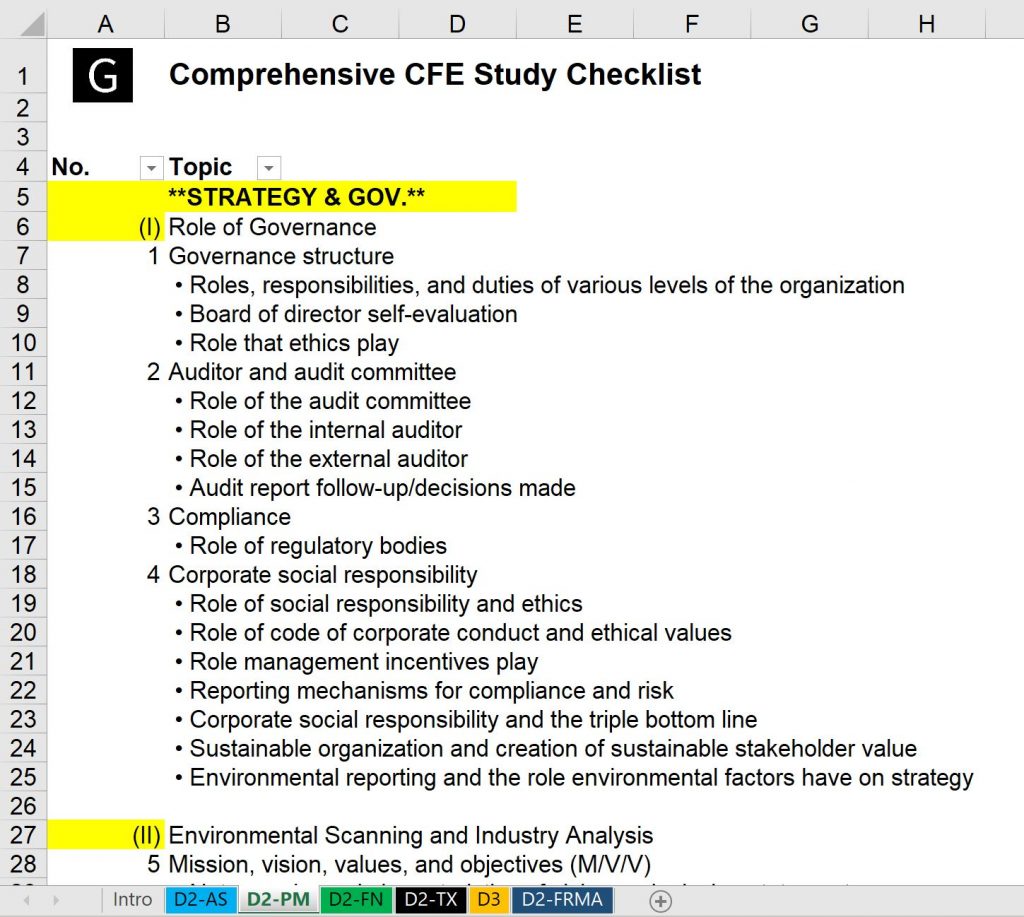
The popular CFE Review program contains all-inclusive list of all topics that can be tested on your CFE for each role, based on the Competency Map. You can preview the program here.


CPA Canada CFE Day 1 J.R. Pets (JRP) Mock Exam Case

The Capstone 1 J.R. Pets Inc. (JRP) case will be tested in September 2023 and September 2024 Common Final Exams (CFEs) on Day 1. The original Capstone 1 case will be made available to candidates enrolled in Capstone 1 and released publicly later by CPA Canada.

How do I prepare for JRP case for the CFE Day 1?

On CFE Day 1, you will be presented with the same JRP case and you will be required to analyze and answer new strategic and operational issues.

Follow these strategies:

  • Step 1: Study the Capstone 1 original case well: It’s important that you know the Capstone 1 case inside-out. You will encounter the same users and similar industry challenges. I suggest making notes of the following key situational analysis factors:
    • Users
    • Mission, vision and values
    • Key success factors (KSF)
    • Strengths, weaknesses, opportunities and threats (SWOT)
    • Board objectives
    • Quantitative analysis
  • Step 2: Know the Capstone 1 strategic issues: In Capstone 1, JRP was facing 4 major strategic issues and several minor issues. In the Day 1 CFE exam, you’ll get 4 new strategic issues.
  • Step 3: Make note of the timeline: CFE Day 1 case is several years in the future and there are new issues to analyze. It helps to stay organized by creating a timeline of events as you are reading the case.
  • Step 4: Understand key stakeholder preferences: JRP case has several users who have opposing views. It’s important that you understand these user preferences as these will repeat in the CFE Day 1.

I strongly recommend practicing with supplemental mock exam cases. In Capstone 2, you will get 3 practice versions of the JRP case. However, most writers find that this is not enough and feel unprepared.

Where can I get extra JRP mock exam cases?

I provide one (1) original J.R. Pets (JRP) supplemental mock exam practice case to help you better prepare for the CFE Day 1. The mock exam case is a realistic simulation of what you may get on your exam and covers typical AOs that you may find in your Day 1. The casepack includes the JRP mock exam case, marking guide and the solution.

Head over to the cases section of my website for a free preview.


CPA Canada CFE Day 1 Kingsdale Tea (KTI) Mock Exam Case

The Capstone 1 Kingsdale Tea Inc (KTI) case will be tested in May 2023 and May 2024 Common Final Exams (CFEs) on Day 1. The original Capstone 1 case will be made available to candidates enrolled in Capstone 1 and released publicly later by CPA Canada.

How do I prepare for KTI case for the CFE Day 1?

On CFE Day 1, you will be presented with the same KTI case and you will be required to analyze and answer new strategic and operational issues.

Follow these strategies:

  • Step 1: Study the Capstone 1 original case well: It’s important that you know the Capstone 1 case inside-out. You will encounter the same users and similar industry challenges. I suggest making notes of the following key situational analysis factors:
    • Users
    • Mission, vision and values
    • Key success factors (KSF)
    • Strengths, weaknesses, opportunities and threats (SWOT)
    • Board objectives
    • Quantitative analysis
  • Step 2: Know the Capstone 1 strategic issues: In Capstone 1, KTI was facing 4 major strategic issues and several minor issues. In the Day 1 CFE exam, you’ll get 4 new strategic issues.
  • Step 3: Make note of the timeline: CFE Day 1 case is several years in the future and there are new issues to analyze. It helps to stay organized by creating a timeline of events as you are reading the case.
  • Step 4: Understand key stakeholder preferences: KTI case has several users who have opposing views. It’s important that you understand these user preferences as these will repeat in the CFE Day 1.

I strongly recommend practicing with supplemental mock exam cases. In Capstone 2, you will get 3 practice versions of the KTI case. However, most writers find that this is not enough and feel unprepared.

Where can I get extra KTI mock exam cases?

I have prepared one (1) original Kingsdale Tea (KTI) supplemental mock exam practice case to help you better prepare for the CFE Day 1. The mock exam case is a realistic simulation of what you may get on your exam and cover typical AOs that you may find in your Day 1. The casepack includes the KTI mock exam case, marking guide and the solution.

Head over to the cases section of my website for a free preview.


September 2022 CPA CFE Cases and Answers (Download)

Similar to prior Common Final Exams (CFEs), the September 2022 CFE had Day 1, 2 and 3 cases.

The following Day 1 cases were tested:

  • CanDo Fitness Ltd. (CFL) v1 (Download)
  • Waste Disposal Inc. (WDI) v3 (Download)

The following Day 2 and Day 3 cases were tested:

  • Day 2 (Download)
    • Tasty Meal Baskets Limited (TMB) (300 minutes)
  • Day 3 (Download)
    • STH Inc. (STH) (90 minutes)
    • TFS Ltd. (TFS) (75 minutes)
    • Brokers Inc. (Brokers) (75 minutes)

For the May 2023 CFE, the following Day 1 cases will be tested:

  • Creative Toys Inc. (CTI) v2
  • Kingsdale Tea Inc (KTI) v1

For the September 2023 CFE, the following Day 1 cases will be tested:

  • CanDo Fitness Ltd. (CFL) v2
  • J.R. Pets Inc. (JRP) v1

Where can I get the solutions?

I have written strong answers to September 2022 CFE cases. When ready, you can get them from here

Will I get these cases in Capstone 2?

If you are registered for the Capstone 2 module for Spring 2023, you will NOT receive these cases at the module. You should download using the links above. If you are someone challenging the exam, such as an internationally trained accountant applying under MRA/MOU, please also download using the links above.

How do I prepare for the CFE?

There are several prep methods for the CFE. You will need to focus on these three items:

  1. Technical knowledge
  2. Case writing skills
  3. Strategy

I speak a lot about these items on my YouTube channel and webinars. You can check out my latest webinar.

Technicals:

  • Know the key topics on each of the competencies
  • Distinguish depth from breadth
  • Debrief

Case writing skills:

  • It’s all about following the CPA Way
  • Know your case inside out
  • Integrate throughout the case

Strategy:

  • Prepare a study plan
  • Obtain study materials
  • Get support and resources

Pass the CPA Canada CFE Exam

I’m Gevorg. I’m an instructor and a CPA exam coach. If you want coaching with me, sign up for my CPA CFE Review Course, for a comprehensive prep package.

CFE Review by Gevorg CPA

Should You Write New CPA cases or Rewrite Prior Ones?

When studying for the CFE and PEP exams, writing cases is critical for success. Since you have limited amount of time to study, you may be wondering, should you write brand new cases or re-write prior ones to firm up your knowledge? Here are 3 reasons why writing new cases is better for your CPA studies.

#1: New cases teach new technicals

The CPA program has so many study resources, you won’t have time to go through all the readings. Writing new cases should be your primary source of learning technical material, because each case is filled with new technicals.

Between reading technicals or writing cases, writing cases is a better way to study for the CPA exams. While study notes and the eBook can be a good source for knowledge, writing cases helps you apply the topics in exam situations. The more cases you write, the more opportunity you have to understand how topics are tested on the exam. You also have a better opportunity of learning non-routine topics.

Rewriting cases you’ve previously written hinders your ability to test your understanding of the material, as you’ve already learned what is tested on the case and how to answer them.

#2: New cases help you practice your case approach

When writing new cases, you will experience situations when you can identify the AO correctly but you’ll be unsure how to answer it correctly. Most candidates’ fear in writing new cases is that they think they don’t know enough to even attempt the case. This shouldn’t be fear factor. If you’re in this situation, then take a guess on such AOs. You’ll be surprised on how often you get it right.

During the exam, you won’t have the opportunity to stop writing and search up the applicable technical. This means it’s critical to learn how to approach these AOs to the best of your ability, as leaving the AO blank is not an option. This is why writing new cases is a better way to study for the exam, it helps you practice your case writing skills.

Remember to attempt AOs through the general CPA response structure:

  • Introduce the issue
  • Assess using the Handbook, ITA, CAS, USO (users strategic objectives)
  • Integrate case facts
  • Explain the implication (i.e. answer the “so what” and “how / why” questions)
  • Recommend

Writing new cases helps you to challenge yourself in developing your responses while replicating an exam setting, as you will already be familiar with the exam requireds on cases you have written previously. It also allows you to reflect on the major technical topics to determine if you feel comfortable addressing them.

#3: New cases teach time management

While rewriting cases can still provide some value in enhancing your time management skills, it takes away the unpredictability that happens during the exam. For example, you already know the number of AOs, where to find them, which ones require more time, etc. When writing new cases, you can truly focus on how to read the case efficiently, prioritize AOs based on your initial impressions, and decide quickly which ones you think will require more time.

The more new cases you write, the more you will be able to learn how to allocate your time, and develop trust in sticking to your time budget. In getting exposure to more new cases, you will come across new topics in which you can create templates that will help you respond in a quicker manner if you come across that required again.

When to rewrite old cases

With all these benefits of writing brand new cases, it isn’t to say rewriting cases is not recommended. It’s about knowing when rewriting cases will add the most value to you.

First, I recommend writing new cases, whether that be new supplemental cases or CPA module cases you’ve written before. After attempting these, you can then rewrite any that you found particularly challenging, or the AOs that you struggled with. For long CFE cases (ie, Day 2 cases), it’s a good idea to re-write only the AOs you struggled in, because you already have good understanding of other topics.

As you get closer to the exam date, rewriting cases holds more value. You can attempt to rewrite a case that you initially wrote at the beginning of your course, that wouldn’t be as fresh in your mind. This allows you to search to find AOs, apply technicals, apply case facts etc. making it feel almost like a new case. The difference now being that you improved your case writing skills since then. This is often a good motivator for candidates to see just how far they’ve come in their learning.

Conclusion

While writing new cases is important for practice, you want to balance this with what is reasonable for you to accomplish. There would be little value in writing a new case, but not having the sufficient time to debrief the cases you’ve already written. Proper debrief includes a review of the feedback guide, the solution, your responses, and summarizing the takeaways. For more tips on how to debrief a case, click here.